Modern marketing is a closed-loop system where customer data informs decisions, decisions shape experiences, experiences are activated across channels, and measurement continuously improves the next decision.
It brings together marketing science and marketing crafts together.
Craft determines what experience the customer actually receives; Science determines who receives it at what point.
What has been the transition:
From traditional CRM: Build Segment → Send Campaign
To modern decisioning: Detect customer context → determine eligibility → predict response/value → choose next best action → personalize →activate.
How do we achieve it today?
Rather than thinking about one “decision-intelligence platform,” I would describe a layered ecosystem - which combined science and craft.
Science:
The foundation is customer data and identity: a data warehouse/lakehouse, CDP, event data, customer profile, behavioral signals, consent and preference data. Data Is the Foundation
Then comes the decisioning layer: That starts with the analytics and modeling layer: SQL, Python/R, BI tools, experimentation platforms, predictive models, propensity, LTV, churn, uplift, segmentation and optimization. Then comes eligibility logic, business rules, next-best-action, adaptive models, arbitration, constraints and economics.
The orchestration and activation layer: email, SMS, Push, Web/App, Customer Care, sales, paid media and journey platforms.
Measurement layer:
Craft:
- Content & Experience: Marketing craft determines things such as:
What is the customer need? What message will resonate? What tone should we use? What should we explain versus sell? Should we create urgency or reassurance? How much information should we show? What creative format is appropriate? What should the next interaction feel like if they don’t respond?
- Human in the loop:
Algorithms are extraordinary at scale, surfacing patterns across millions of interactions that no person could hold in their head. But knowing when to override a model, when to add a guardrail, or when a segment needs its own rules entirely, that’s still a deeply human skill.
And across all of this sits governance: privacy, consent, model monitoring, explainability, auditability, brand safety, escalation, data quality and observability.
There is no universal Martech Stack. But there is a common capability flow. From Data to Decisions to Experience to Measurable Outcomes - all to drive better customer experience. Here is a simple CRM/Lifecyle architecture from customer data to learning.
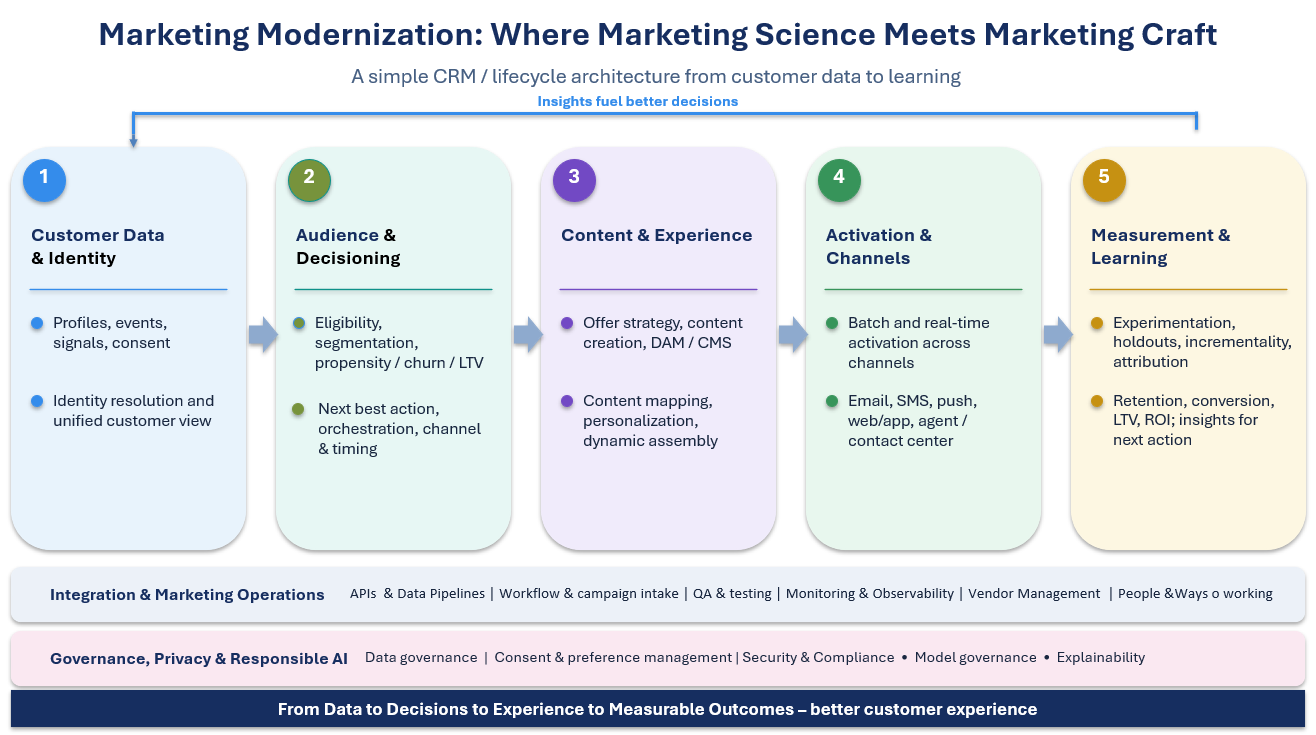
Marketing Technology stack can be assembled in different ways based on your organization need. It depends on your size, maturity, complexity and economics.